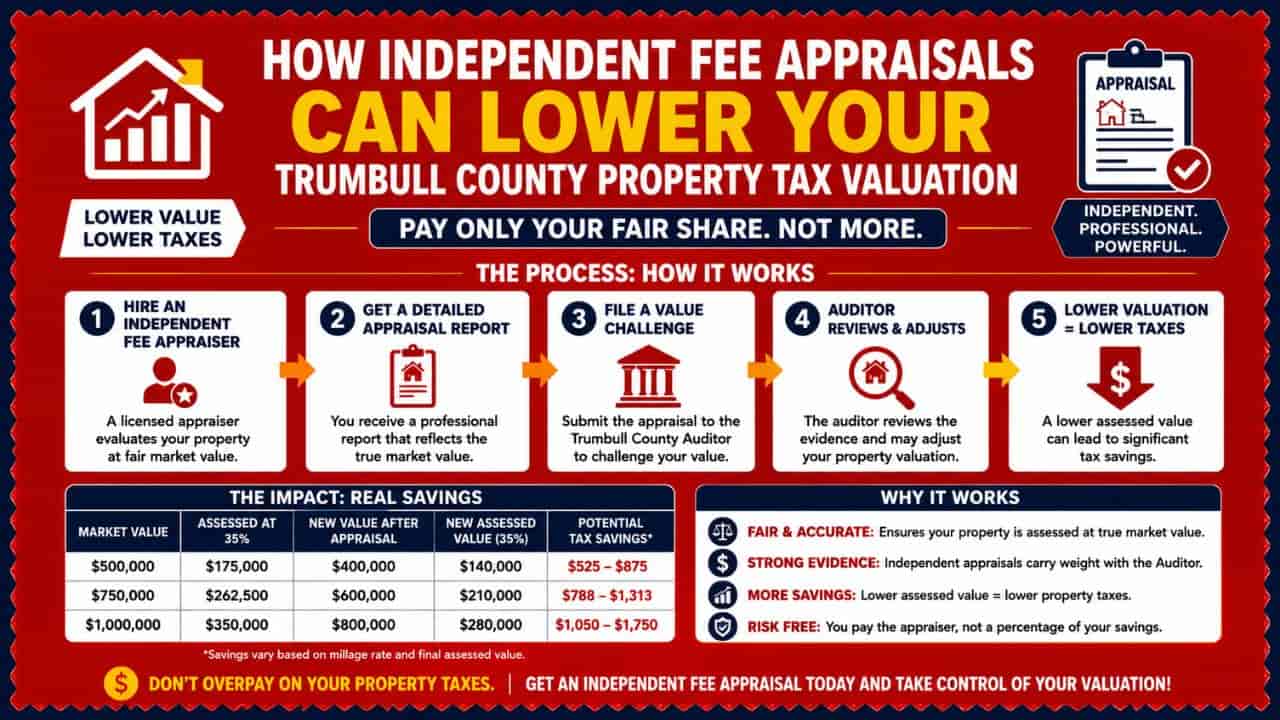
Trumbull County real estate is undergoing a structural economic shift driven by changing demographics, updated tax regulations, and moving inventory trends. For local property owners and commercial investors, navigating the intersection of localized property tax inflation and shifting community populations is essential to preserving real estate equity. Relying on verified public records and historical data datasets from 2021 through 2026, this authoritative market insight guide breaks down local real estate metrics city by city. Whether you are analyzing neighborhood parcel updates, reviewing historical sales volumes, or studying the financial impact of regional tax levies, this comprehensive manual provides clear solutions to tracking local real estate performance.
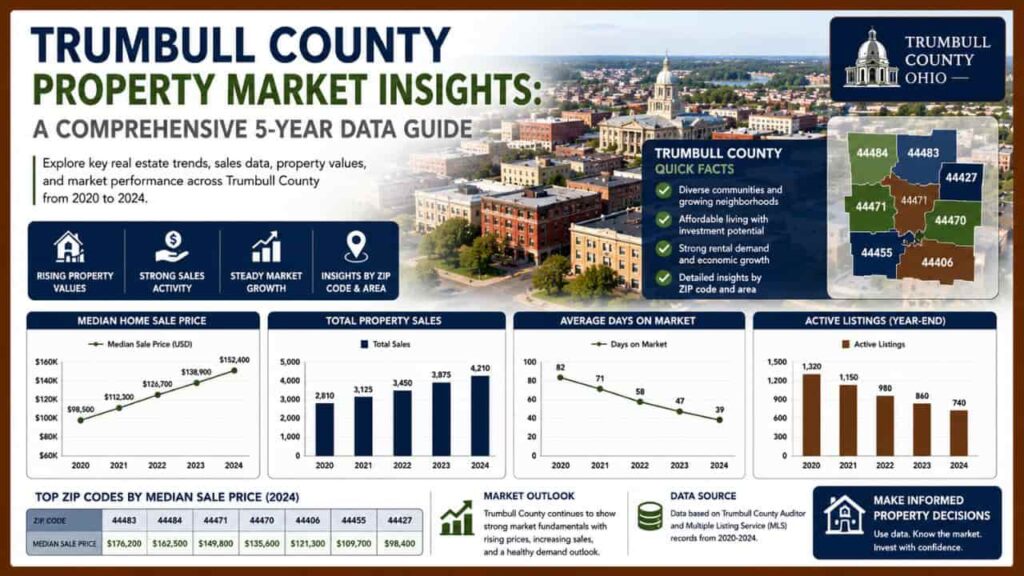
Trumbull County Real Estate Footprint: A Zip Code and City-Wise Directory
Analyzing real estate values requires localized geographic mapping because local tax liabilities fluctuate according to specific school districts and municipal boundaries. In Trumbull County, municipal service networks are structurally grouped by unique postal zones that determine primary real estate tracking parameters.
Major Urban and Suburban Hubs
- Warren (44481, 44483, 44484, 44485): As the county seat, Warren serves as the highest-density zone for real estate parcel searches. This region features the highest aggregate volume of single-family housing stock and commercial storefront conversions across the county.
- Niles (44446): A prominent industrial and commercial retail hub. Niles properties are heavily impacted by commercial corridor activity along regional transit routes and localized municipal utility lines.
- Cortland (44410): Characterized by premium suburban developments, higher baseline valuations, and a consistent demand for newer residential construction models.
- Hubbard (44425) & Girard (44420): Key eastern boundary communities experiencing stable transactional velocity due to their geographic proximity to border transport networks.
Tracking 5 Years of Local Property Tax Inflation (2021–2026)
Property tax calculations inside Ohio do not remain static. Over the last five years, Trumbull County real estate owners have faced varying levels of valuation growth and tax rate inflation.
Understanding Tax Growth Adjustments
Between 2021 and 2026, localized property tax growth has been influenced by state-mandated reappraisal updates, statistical mid-period revisions, and newly passed voter levies for public school systems and emergency response services. Under Ohio Revised Code (ORC) guidelines, real estate taxes are levied against 35% of a property’s appraised fair market value.
Taxable Assessment Base = Appraised Fair Market Value x 0.35
While Ohio’s House Bill 920 prevents direct tax collection inflation on fixed-dollar voter levies when values rise, “inside millage” (the unvoted 10 mills allowed by the state constitution) escalates automatically alongside rising market values. Over the past 5 years, high-growth pockets like Cortland and specific sections of Howland Township saw real estate tax bill increases ranging from 8% to 15% due to updating neighborhood sales parameters and localized school infrastructure updates.
Market Activity Analytics: Sales Volumes and New Construction Data
The baseline stability of a real estate market is measured by examining existing home sales velocity alongside the volume of newly issued building permits. Over the 2021 to 2026 lookback window, economic headwinds and fluctuating mortgage interest rates altered how quickly housing stock moved across Trumbull County.
Existing Home Sales Performance
During the peak real estate market windows of 2021 and 2022, residential homes moved rapidly, averaging under 25 days on the market. By mid-2026, the local market normalized. Current public records indicate the median sale price for Trumbull County residential assets rests near $180,000, with average transaction times spanning approximately 32 days on market.
New Construction Tracking
New housing development remains highly localized. The vast majority of residential building permits issued over the past five years are concentrated in suburban master-planned sub-divisions rather than urban centers.
The 3-column table below provides a specialized statistical synthesis of regional property action, tax inflation trends, and housing inventory metrics across primary municipal tracking zones.
| Municipal Boundary & Zip Code | 5-Year Property Tax Growth Spectrum | Est. Inventory Velocity (Sales & New Builds) |
| Warren Urban Core (44483 / 44485) | Moderate baseline growth; driven primarily by inner-city utility revisions. | High turnover of historic inventory; limited new construction projects. |
| Cortland Suburban (44410) | Accelerated tax adjustment due to rising market valuations. | Steady market value appreciation; highest share of premium single-family starts. |
| Niles Commercial Zone (44446) | Variable adjustment influenced by local education infrastructure levies. | Fast-moving multi-family rental assets; consistent commercial sales profile. |
| Hubbard / Girard (44425 / 44420) | Stable, predictable millage progression with minimal local spikes. | Moderate residential absorption rate; balanced buyer-to-seller inventory levels. |
Demographics vs. Housing Inventory: The 5-Year Population Correlation
A major driver of long-term real estate value is the balance between population shifts and available housing units. Understanding this relationship helps explain why property valuations continue to experience upward pressure despite subtle shifts in macro-level county demographics.
The Inventory Crunch
According to U.S. Census Bureau and local public registries, Trumbull County’s aggregate population has shown a marginal downward trajectory over the past decade, currently stabilizing around 190,000 residents. However, the total number of independent households has remained steady. This trend reflects a changing demographic profile featuring smaller average family sizes per household unit.
Evaluating the Structural Disconnect
Because the number of independent household structures required by residents remains high, housing inventory is tight. This structural disconnect explains why home prices climbed steadily over the 5-year lookback window:
- Household Downsizing: Older residents are transitioning out of massive family estates into smaller single-level units, intensifying competition for mid-tier properties.
- Low Construction Rates: Total annual building permits across the county average fewer than 120 new residential structures per year, failing to replace aging housing stock.
- High Owner-Occupancy: Trumbull County maintains a high owner-occupancy rate of over 71%, which naturally limits the number of properties entering the active sales market each year.
Ohio Administrative Frameworks: Trumbull County vs. Stark County
When evaluating local real estate insights, property owners must understand that data collection structures are regulated uniformly across the state of Ohio. Independent county offices deploy specialized software systems to host, process, and display public real estate records.
For instance, the Trumbull County Auditor’s office has rolled out an upgraded web communication portal designed to streamline multi-device user access for parcel lookup and GIS mapping arrays.
When assessing data management models, comparing local systems to nearby regional configurations provides helpful technical perspective:
- Data Entry Standardization: Both Trumbull and Stark County systems process real estate transactions using automated electronic conveyance sheets, which updates public sales data registries within 48 hours of legal recordation.
- Public Services Delivery: While the Stark County Auditor offers a centralized online portal framework for tracking historical valuation trends, the Trumbull County web framework has updated its digital map layers to help users track regional school district boundaries and infrastructure levy lines easily.
- System Integrity Protection: Both regional entities follow strict data validation protocols managed by the Ohio Department of Taxation to ensure property valuations remain uniform and compliant with state codes.
Step-by-Step Solution: Resolving Data and Tax Discrepancies
If you review local real estate insights and realize your specific property parcel data is recorded incorrectly, or that your tax bill reflects an improper valuation spike, use this official administrative procedure to resolve the issue.
Step 1.Executing a Comprehensive Digital Parcel Verification: Record Audit.
Log into the updated county real estate web portal. Enter your permanent parcel ID to review the recorded structural attributes of your property, including square footage, bedroom counts, and commercial additions.
Step 2. Filing for an Administrative Clerical Correction: Error Identification.
If you uncover a simple factual error such as an incorrect acreage notation or a miscalculated building age file a formal correction request directly with the auditor’s appraisal department to adjust the data without a formal legal hearing.
Step 3. Submitting a Valuation Complaint to the Board of Revision: Financial Valuation Appeal.
If the discrepancy centers on an inflated market valuation following a local mass reappraisal, complete DTE Form 1 (Complaint Against the Valuation of Real Property). Submit the document to the local Board of Revision between January 1 and March 31.
Step 4. Attending the Official Review Hearing: Evidence Presentation.
Gather clear supporting evidence, including a recent certified independent appraisal or documented closing statements from local neighborhood sales. Present these facts to the board members to secure a formal assessment correction and reduce your annual tax liability.
Conclusion
Analyzing Trumbull County property market insights over a 5-year trajectory provides essential clarity for local investors. Tracking shifting demographics alongside property tax inflation trends across localized zip codes reveals how tight housing inventory maintains strong upward price pressures. By leveraging accurate data from the Trumbull County Auditor portal, comparing systems with the Stark County Auditor, and utilizing formal appeal channels, real estate owners can make strategic, data-backed property decisions.
FAQs
How many ZIP codes are located within Trumbull County, Ohio?
Trumbull County contains over 25 unique ZIP codes mapping various cities, villages, and rural townships, each possessing specific school district tax rates and baseline valuations.
Why are property values rising if Trumbull County’s population is shifting?
While the total population shows minor declines, the overall number of independent household units remains high, creating an inventory crunch that continuously drives up market values.
How is property tax inflation calculated during an Ohio market assessment?
Ohio taxes real estate based on an assessed taxable value, which is legally limited to 35% of the total appraised fair market value calculated by the county auditor.
What role do the Trumbull and Stark County auditors share in real estate updates?
Both offices operate under uniform state laws as independent fiscal watchdogs, managing public GIS mapping layers, automated property conveyance tracking registries, and online service guides.
What is the deadline to appeal an inflated property valuation notice?
Property owners must formally submit DTE Form 1 to the local Board of Revision between January 1 and March 31 of the year following the valuation adjustment.