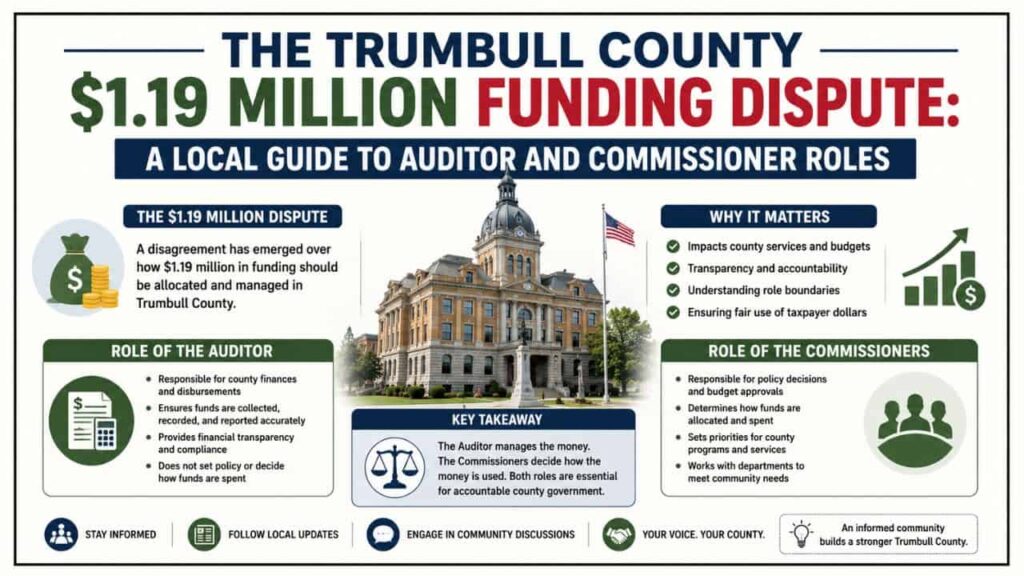
The Trumbull County Auditor’s Office is locked in a high-stakes fiscal standoff with the County Commissioners over a $1,192,359 funding claim. For local taxpayers, this complex administrative battle shapes how county offices operate, how public records are maintained, and how local tax revenues are managed. Understanding the layers of Ohio county governance can be confusing, but understanding this dispute is essential. This expert guide breaks down the conflict, maps out exactly how Ohio county infrastructure functions, and clarifies how these fiscal disputes impact public services.
The Anatomy of the Trumbull County Funding Dispute
At its core, this dispute centers on public money allocations dating back to 2019. Trumbull County Auditor Martha Yoder is requesting a formal reimbursement of $1,192,359 from the Trumbull County Commissioners. The disagreement focuses heavily on the funding and payroll of the county’s tax map program employees.
While the Commissioners manage the county’s general fund and overall budget allocations, the Auditor serves as the chief fiscal officer. Auditor Yoder argues that the specific funding mechanism used over the last several years improperly burdened certain accounts, requiring a massive million-dollar correction to balance the books and protect office resources.
How Ohio County Governance Works: Auditor vs. Commissioners
To fully understand why this dispute happened, it is crucial to understand how county governance is set up under Ohio Revised Code (ORC). Ohio counties do not have a single “mayor” or “CEO.” Instead, power is split among multiple independent elected officials to ensure checks and balances.
The Role of County Commissioners
The Board of County Commissioners acts as the county’s central budgeting authority. They pass the annual budget, manage county property, and determine funding levels for virtually all county departments. However, they cannot dictate exactly how another elected official runs their specific office.
The Role of the County Auditor
The County Auditor is the central hub for local government finance. The office has two main jobs:
- Chief Fiscal Officer: Managing the county payroll, issuing checks for county expenses, and preparing the annual comprehensive financial report.
- Real Estate Assessor: Determining property values for taxation, managing geographic information systems (GIS) mapping, and supervising the tax map office.
Trumbull County vs. Stark County: A Structural Comparison
While this specific $1.19 million dispute is unique to Trumbull County, the underlying structural setup is identical across Ohio. For instance, looking at the Stark County Auditor’s role provides an excellent blueprint for how these offices should ideally operate when managing real estate and public records seamlessly.
The table below highlights how the responsibilities line up across these neighboring regions, showing that whether you are looking at Trumbull or Stark County, the fundamental duties remain tied to public accountability.
| County Entity | Primary Fiscal Accountability | Real Estate & Tax Mapping Scope | Oversight Mechanism |
| Trumbull County Auditor | Manages a $1.19M dispute over tax map payroll accounts. | Oversees local property valuations, parcel transfers, and GIS data. | Governed by Ohio Revised Code; answers to local voters. |
| Stark County Auditor | Administers countywide budget disbursement and payroll checks. | Leads a robust guide for auditor services, mapping, and licensing. | Acts as an independent financial watchdog for Stark County. |
| County Commissioners | Approves the overall general fund budgets for all county offices. | Funds the physical infrastructure and public mapping departments. | Holds final approval on countywide legislative and fiscal policies. |
Step by Step Resolution: How Ohio Fiscal Disputes Get Settled
When two independent branches of local government reach a million-dollar stalemate, the path to a solution follows a strict administrative and legal sequence. Here is how a conflict like the Trumbull County funding dispute moves toward a final resolution.
Step 1. Internal Auditing and Claims Submission: Identifying the Variance.
The County Auditor reviews historical financial ledgers, isolates specific account discrepancies (such as the $1.19 million tax map payroll issue), and submits an official statutory request for reimbursement to the Board of Commissioners.
Step 2. Board Review and Public Hearings: Administrative Evaluation.
The County Commissioners place the fiscal demand on their meeting agenda. Legal counsel, often from the County Prosecutor’s office, reviews the claim to determine if the general fund is legally obligated to return the requested money.
Step 3. Mediation and Prosecutor Opinion: Statutory Legal Guidance.
Because the County Prosecutor represents both the Auditor and the Commissioners, an outside statutory legal opinion or independent mediator is often brought in to resolve the conflicting interpretations of Ohio budget law.
Step 4. Mandamus Action or Court Settlement: Judicial Resolution.
If administrative talks fail completely, the Auditor can file a lawsuit (frequently a writ of mandamus) in the court of common pleas or the Ohio Supreme Court, forcing a judge to rule on exactly how the county funds must be distributed.
Why This Dispute Matters to Local Property Owners
It is easy to look at a million-dollar administrative dispute and assume it does not affect everyday citizens. However, this standoff has real-world consequences for local homeowners, businesses, and residents.
- Public Service Delays:
When funding for the tax map office is disputed, it can slow down the processing of deed transfers, property boundary updates, and GIS mapping updates. This directly impacts real estate transactions. - Taxpayer Accountability:
Every dollar spent on legal disputes, independent audits, or court filings is money coming directly from local tax revenues. Clean, transparent resolution ensures your hard-earned tax dollars go toward public infrastructure rather than bureaucratic gridlock. - Operational Stability:
A stable, well-funded Auditor’s office ensures that property appraisals remain accurate, uniform, and fair across the entire county.
If you are currently processing property transfers or monitoring tax rates in Trumbull County, staying informed on these administrative updates will help you anticipate potential processing timelines and understand the broader health of your local government’s financial system.
Conclusion
The Trumbull County Auditor funding dispute highlights the critical balance of power in Ohio county governance. Understanding how the Board of County Commissioners allocates tax funds ensures transparency for local property owners. As the chief fiscal officer navigates this $1.19 million dispute, tracking these updates protects your real estate assets, ensures accurate public records, and maintains seamless countywide financial stability.
FAQs
What is the main Trumbull County Auditor funding dispute about?
The Trumbull County Auditor is requesting a $1.19 million refund from county commissioners over historical tax map program payroll and budget account allocations dating back to 2019.
How does this dispute affect my local property taxes?
While it doesn’t change your current tax rate, administrative disputes can delay real estate parcel search updates, deed transfers, and official GIS mapping records processing.
What is the role of the Trumbull County Commissioners in this issue?
The Board of County Commissioners serves as the central budgeting authority managing the general fund, deciding whether the auditor’s office receives the requested budget reimbursement.
How do Ohio county auditor duties compare across counties?
Whether tracking the Stark County Auditor or Trumbull, all Ohio auditors act as chief fiscal officers managing real estate appraisals, payroll, and auditor services guides.
How will this million-dollar administrative conflict be resolved?
If internal mediation through the county prosecutor fails, the dispute will be settled through a binding judicial ruling or a formal administrative fund settlement.