
Public sector cyber security is no longer an afterthought, it is a critical pillar of local government operations. In recent years, public agencies across Ohio have increasingly become prime targets for sophisticated digital fraud syndicates. A prominent example occurred when a security breach involving a Trumbull County municipality resulted in a loss of over $160,000 in public funds. The incident exposed major structural vulnerabilities in administrative file sharing, communication verification, and localized fiscal oversight. This comprehensive case study analyzes the mechanics of the compromise, reviews the subsequent legal rulings under the Ohio Revised Code, and outlines the precise security upgrades implemented to safeguard public assets moving forward.
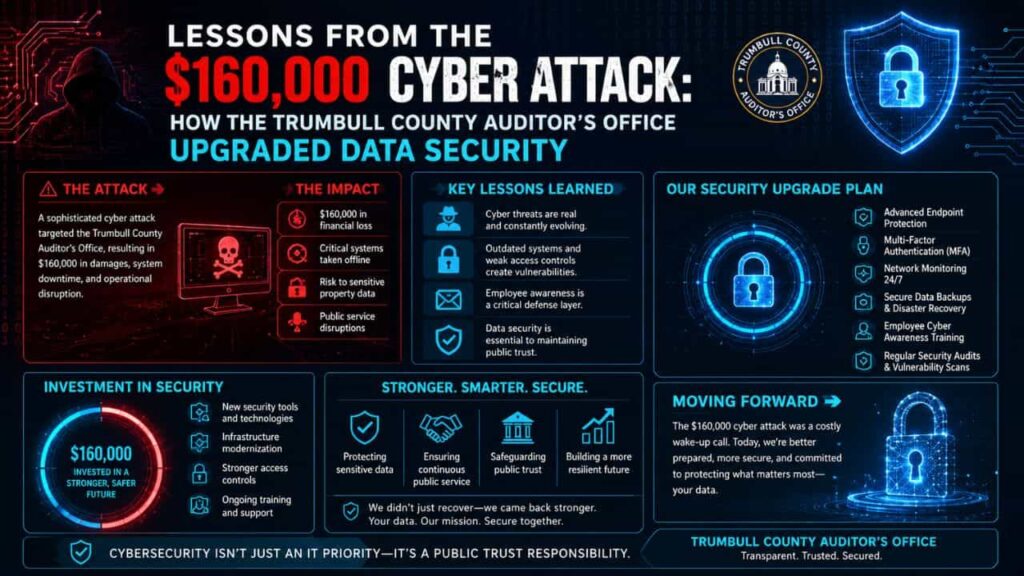
Anatomy of a Public Sector Cyber Breach: The $160,000 Incident
Understanding how a major digital exploit occurs requires looking past basic email phishing definitions. The vulnerability in Trumbull County was an advanced, targeted structural compromise that targeted automated direct-deposit routines.
The Core Vulnerability
The breach stemmed from a compromise within a localized township administration network. Cybercriminals gained unauthorized access to the Microsoft Office 365 ecosystem belonging to a local municipal fiscal officer. Crucially, basic multi-factor authentication (MFA) protocols on the targeted account had been temporarily deactivated. This allowed the unauthorized attackers to operate inside the internal email network completely undetected for several weeks, studying past funding transaction layouts.
The Mechanics of the Diversion
Using the authentic, compromised local government email address, the threat actors contacted the Trumbull County Auditor’s office with a fraudulent administrative request. They provided updated routing and banking information, instructing county clerks to redirect regular real estate tax advances, manufactured home taxes, and gasoline excise revenues away from standard municipal accounts to an alternative online digital banking platform.
Because the request originated from an authentic local domain, county personnel executed the changes without secondary verification, resulting in eight separate fraudulent transactions totaling exactly $160,857.18.
Statutory Liability and Legal Precedents Under Ohio Law
The aftermath of the cyber attack sparked an intensive legal debate over which governmental entity bears the financial burden when electronic fraud occurs. The resolution required formal intervention by the Ohio court system and a careful evaluation of the Ohio Revised Code (ORC).
The Judicial Ruling
The local township filed legal action against the county auditor’s office to recover the missing tax distributions. The Trumbull County Common Pleas Court, with subsequent backing from the 11th District Court of Appeals, ruled that cybercrime does not clear a public official of their foundational statutory obligations.
The court held that the county auditor holds a statutory duty to ensure that collected public tax revenues successfully reach the precise legal authority for which they are intended. Ultimately, the court ordered the auditor’s office to reimburse the township its remaining unrecovered balance of $80,857 plus statutory interest.
Regional IT Benchmarking: Trumbull County vs. Stark County Infrastructure
The financial fallout from this incident prompted county auditors across the state of Ohio to perform comprehensive operational security reviews. Standardizing public accounting safety requires comparing local system upgrades against established regional benchmarks.
For instance, neighboring agencies utilize varying technical frameworks to manage automated real estate transactions, electronic data processing, and localized verification rules.
The 3-column table below highlights the operational differences in how administrative systems divide responsibility when securing digital financial networks, ensuring entities deploy an effective guide for auditor services:
| Public IT Administration Authority | Core Network Security Requirements | Banking Verification Protocols | Public Fund Protection Accountability |
| Trumbull County Auditor Office | Mandates non-bypassable, system-wide multi-factor authentication for all remote systems. | Requires mandatory in-person signatures or verbal phone calls to update banking details. | Enforces immediate notification routines with local prosecutors and sheriff networks. |
| Stark County Auditor Portal | Deploys specialized network detection scripts to flag abnormal external data updates. | Restricts bank account adjustments through encrypted, multi-tier administrator panels. | Provides a secure guide for auditor services to track rolling levy and fiscal distributions. |
| Ohio Auditor of State (Faber) | Tracks countywide data compliance during standardized annual fiscal reviews. | Mandates formalized, written operational policies for all public fund transactions. | Issues binding findings for recovery if internal employee safety policies are bypassed. |
Step-by-Step Guide: The Upgraded Bank Verification Sequence
To eliminate the risk of duplicate fraud issues and protect public funds, the auditor’s office revised its financial accounting workflows. Any request to alter corporate banking or routing codes now requires a rigorous multi-step validation sequence.
Step 1. Flagging Incoming Routing Modification Forms: Electronic Request Isolation.
When a municipal entity sends a digital request to modify direct deposit accounts, the automated accounting framework intercepts the document, places a temporary freeze on outgoing transfers, and routes it to an isolated security queue.
Step 2.Executing Independent Out-of-Band Phone Verification: Out-of-Band Identification.
Clerks are prohibited from replying to the source email. Instead, personnel must consult an offline, verified directory to call the local official directly via phone, confirming that the routing transfer request is authentic.
Step 3. Requiring Mandatory Paper Checks and Physical Audits: Physical Sign-Off Processing.
The initial three transactions following an approved banking shift are distributed via traditional paper checks. An office manager and IT director must physically inspect and co-sign the physical vouchers before release.
Step 4. Finalizing the Encrypted System Update Notification: Registry Reconciliation.
Once identity parameters match perfectly, the system updates the digital registry. An automated secondary security alert is transmitted to all board trustees, documenting the precise time and nature of the configuration change.
Critical Solutions for Public Sector Cyber Preparedness
Local governments and businesses handling automated public transactions should implement these primary defensive strategies to defend against advanced network exploits:
- Enforce Non-Negotiable MFA Policies: Deactivating multi-factor authentication on any system handling financial records must be strictly prohibited across all departments and subdivisions.
- Conduct Routine Phishing Simulations: Implement rolling cybersecurity training programs to ensure employees recognize sophisticated spear-phishing techniques that mimic authentic regional contacts.
- Establish Clear Written Policies: Never update transactional distribution data based solely on email correspondence. Always require a secondary, independent verification method before altering financial fields.
Conclusion
The Trumbull County Auditor security breach serves as an essential case study for modern municipal risk management. Under Ohio state law, data vulnerabilities like disabled multi-factor authentication can lead to severe losses of public funds. By implementing strict out-of-band verification workflows, conducting system audits, and mirroring robust frameworks found at the Stark County Auditor, local government watchdogs can successfully defend their networks against evolving cyber threats.
FAQs
What caused the $160,000 cyber attack in Trumbull County?
An attacker compromised a township email account where multi-factor authentication was disabled, allowing them to send fraudulent bank update requests to the auditor’s office.
Who was held legally responsible for the lost public funds?
Ohio appellate courts ruled the county auditor retained a statutory duty to ensure funds safely reached the correct municipality, ordering a partial reimbursement.
What is out-of-band verification in municipal banking updates?
It is a safety protocol requiring employees to independently confirm financial account changes using a separate communication channel, such as an official voice phone call.
How do Trumbull and Stark County auditors protect transaction data?
Both agencies deploy advanced network security guides, requiring non-negotiable multi-factor authentication profiles and automated system alerts to monitor public accounting updates.
Can a public employee be held personally liable for cyber fraud?
Yes. The Ohio Auditor of State emphasizes that if an employee explicitly bypasses written internal security controls, the financial burden can shift to them personally.