If you live in Trumbull County, Ohio, understanding how your property is valued is essential to ensure that your property taxes are fair and accurate. Many homeowners receive their annual property valuation notice but aren’t sure how these values are calculated or what to do if they believe their property is assessed too high.
This guide explains each stage of the Property Value Assessment Process in Trumbull County, how the County Auditor’s Office determines values, and what actions you can take to verify or appeal your assessment.
What Is the Property Assessment Process?
A property value assessment is an official estimate of your home or land’s market value, conducted by the Trumbull County Auditor’s Office.
This valuation determines how much property tax you owe based on state laws and local millage rates.
Each parcel of land in Trumbull County is periodically reviewed to ensure that the assessed values reflect current market conditions.
Step 1: Property Data Collection and Review
The assessment process starts with gathering accurate information about your property.
The Auditor’s Office maintains detailed records that include:
- Lot size and property location
- Type of structure (residential, commercial, industrial, or agricultural)
- Year built and square footage
- Renovations, improvements, or demolitions
- Recent sales data of comparable properties
When needed, field appraisers visit properties to verify updates or physical changes.
Your Role:
If you’ve remodeled, built an addition, or demolished any part of your property, report it to the Auditor’s Office promptly. Keeping your records accurate ensures your value reflects reality.
Step 2: Determining the Market Value
The market value is the estimated price your property would sell for in an open and fair market.
The Trumbull County Auditor uses a mass appraisal system that combines three main methods:
- Sales Comparison Approach: Compares your property with similar properties sold recently in your area.
- Cost Approach: Calculates replacement cost minus depreciation.
- Income Approach: Used mainly for rental or commercial properties.
Your Role:
You can verify your property’s market value using the Trumbull County Auditor’s property search tool by comparing it with recent neighborhood sales.
Step 3: Calculating the Assessed (Taxable) Value
Once the market value is established, it is converted into an assessed value (Property Value Assessment) the portion subject to taxation.
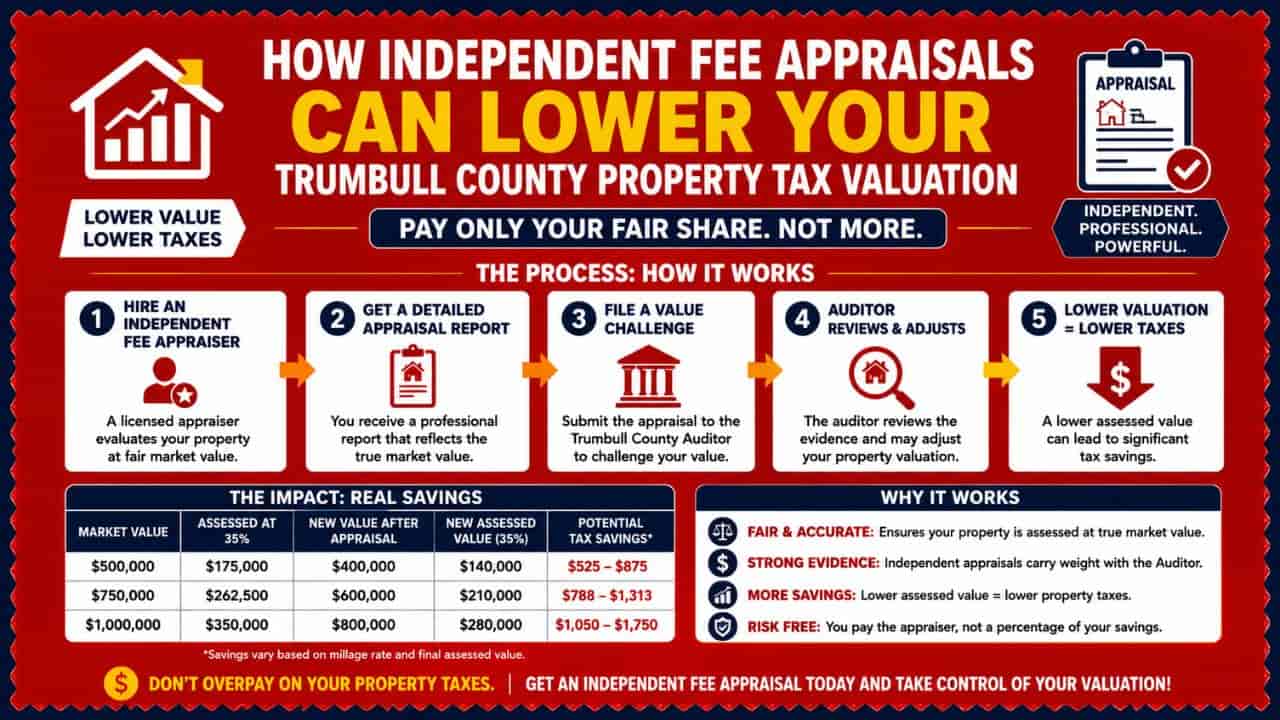
In Ohio, the assessed value equals 35% of the market value.
Example:
If your home’s market value is $200,000, the assessed value will be $70,000.
Your property tax is calculated using this assessed value multiplied by the applicable local millage rate.
Step 4: Reappraisal and Triennial Update
To keep assessments fair, the state mandates two types of valuation reviews:
- Sexennial Reappraisal (Every 6 Years): A full, in-person review of all properties.
- Triennial Update (Every 3 Years): A statistical update using recent sales data without site visits.
These updates ensure property values align with current real estate trends in Trumbull County.
Your Role:
Review your reappraisal notice carefully. If your property’s value looks incorrect, prepare evidence to challenge it.
Step 5: Adjustments and Special Changes
Sometimes your property value changes between reappraisals due to special situations such as:
- New construction or building additions
- Demolition or removal of structures
- Fire, flood, or storm damage
- Property classification changes (e.g., from residential to commercial)
Your Role:
Report any major change to the Auditor’s Office to make sure your tax bill stays accurate.
Step 6: Review Your Value Notice
Once Property Value Assessment are complete, you’ll receive a valuation notice listing:
- New market value
- Assessed value (35% of market)
- Estimated property tax amount
Your Role:
Check this notice as soon as you receive it. If you agree with the amount, no action is needed. If not, you can file an appeal.
Step 7: How to Appeal Your Property Value
If you believe your property is overvalued, file a Complaint Against the Valuation of Real Property (DTE Form 1) with the Trumbull County Board of Revision.
Appeal Process Overview:
- File the complaint by March 31 of the tax year.
- Attach supporting evidence such as:
- Recent comparable property sales
- Appraisal reports
- Photos showing defects or damage
- Recent comparable property sales
- Attend a hearing to explain your case.
- Wait for the Board’s decision, which can lower your assessed value if justified.
Step 8: Apply for Tax Exemptions or Credits
After your assessment is finalized, you may still qualify for programs that reduce your property tax:
- Homestead Exemption: For seniors (65+) or permanently disabled homeowners.
- Owner-Occupancy Credit: For those living in their primary home.
- Veteran Disability Exemptions: For qualified veterans or surviving spouses.
Your Role:
Submit exemption forms through the Trumbull County Auditor’s Office and check eligibility each year.
Step 9: Monitor Your Property Record
The Trumbull County Auditor’s online tools allow you to:
- Search your property by name, address, or parcel number
- View assessed and market values
- Estimate your taxes using the county’s Tax Estimator Tool
- Review appeal and exemption history
Staying updated ensures your record is correct and your taxes remain fair.
Summary of the Assessment Process
| Step | Action | Responsible Office | What You Should Do |
| 1 | Data collection | Auditor’s Office | Keep records updated |
| 2 | Market value estimation | Auditor’s Office | Compare with neighborhood sales |
| 3 | Assessed value set | Auditor’s Office | Understand 35% taxable value |
| 4 | Reappraisal/update | State-mandated cycle | Review notices |
| 5 | Special adjustments | Auditor’s Office | Report property changes |
| 6 | Notice issued | Auditor’s Office | Review and verify |
| 7 | Appeal (if needed) | Board of Revision | File by March 31 |
| 8 | Apply for exemptions | Auditor’s Office | Submit eligible forms |
| 9 | Monitor records | Online portal | Stay informed |
Conclusion
The Property Value Assessment Process in Trumbull County ensures every property owner contributes their fair share of local taxes.
By understanding how your property value is determined, regularly reviewing notices, and appealing when necessary, you can protect yourself from overpayment and maintain accurate tax records.
Stay proactive and connected with the Trumbull County Auditor’s Office to ensure your property remains fairly valued year after year.
FAQs
How often is property reassessed in Trumbull County?
Every property is reappraised every 6 years, with statistical updates every 3 years.
How is my property tax calculated?
It’s based on 35% of your property’s market value, multiplied by the applicable local millage rate.
Why did my property value increase this year?
Values can rise due to updated market trends, new construction, or county-wide reappraisals.
Can I appeal my property value?
Yes. File a Board of Revision complaint by March 31 of the current tax year with supporting evidence.
What exemptions can I apply for?
Common exemptions include the Homestead Exemption, Owner-Occupancy Credit, and Veterans Disability Exemption.